By: Kendall Upton
Updated: March 18, 2026

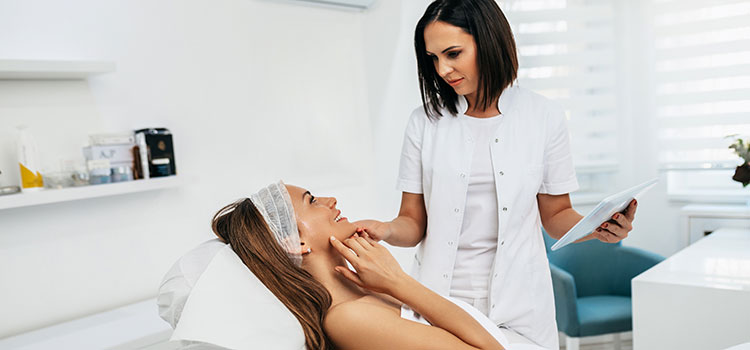
Estheticians are licensed skincare professionals devoted to improving the health and appearance of their clients’ skin. Although the practice of beautification has been around since ancient times, it wasn’t until the late 19th and early 20th centuries that the beauty industry became a viable career path for women.
The esthetics industry as we know it today didn’t really start to take root until around the 1970s, and since then it has practically exploded. Today, people recognize the importance of taking care of their skin and seek out estheticians to correct certain skincare issues or simply feel pampered.
Some of the most common skincare services that estheticians perform include the following:
| Common services / treatments offered | Definition and / or examples |
|---|---|
| Facials | Cleansing, steaming, exfoliating and moisturizing the skin |
| Extractions | Removes blackheads |
| Superficial chemical peels | Used to rapidly exfoliate the skin |
| Hair removal | Can be done through waxing, tweezing and threading |
| Skin masks | Often used to cleanse and exfoliate the entire body, common examples include clay masks, sugar scrubs and seaweed wraps |
| Makeup application | Apply makeup on the client using an understanding of color theory |
As skincare specialists, estheticians generally spend most of their time consulting with clients one on one to determine the best treatments for their skincare needs and then performing those treatments on the client.
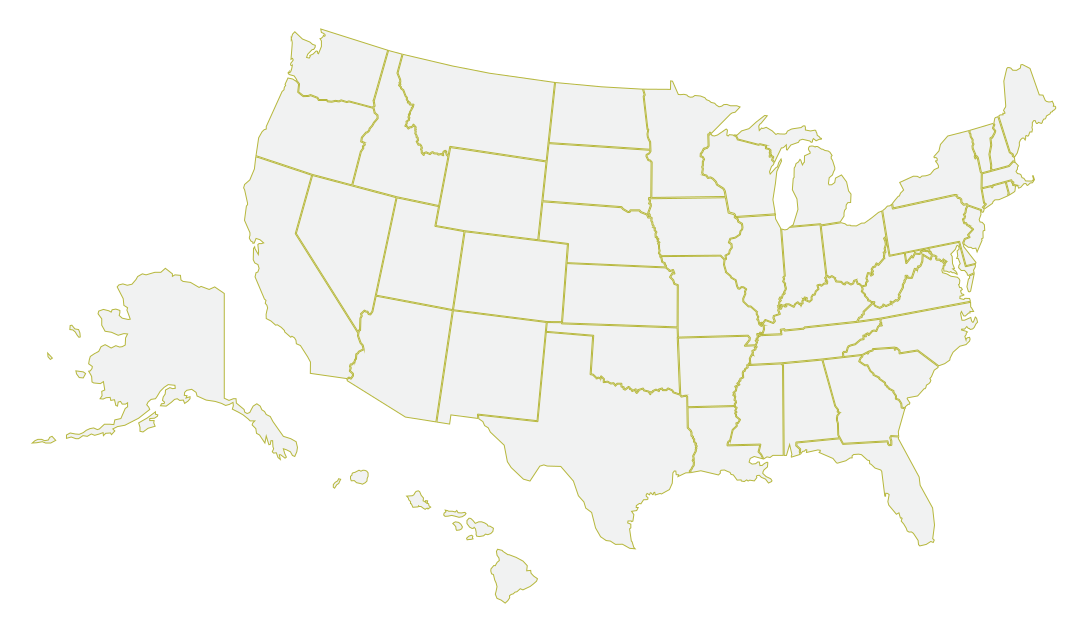
Many people known estheticians for their signature services like facials and waxing, but there’s so much more they can do. However, it’s important to point out that estheticians don’t have uniform scope of practice laws everywhere. That means that some states allow estheticians to do certain services that other states do not.
Estheticians don’t have uniform scope of practice laws everywhere. That means that some states allow estheticians to do certain services that other states do not.
“Unfortunately, we now have a patchwork quilt of job tasks of what an esthetician can do,” said Susanne S. Warfield, Founder and Executive Director of the National Coalition of Estheticians Association (NCEA).
Warfield said that when they were creating the NCEA’s esthetician certification, they had to figure out which knowledge and skills to test candidates on based on what estheticians across the country knew how to do.
“We had to conduct what’s called a job task analysis or JTA. We actually didn’t do one, we did three. And we did them geographically around the country in order to determine the core tasks that estheticians provide,” Warfield said. Using the results of their job task analysis, the NCEA created a list of knowledge areas and tasks that they believe an esthetician should know upon completing a 600-hour esthetician program.
With the job task analysis in mind, estheticians can generally expect to do the following:
It’s important to note that estheticians cannot diagnose skin conditions or prescribe medication—these tasks are left to dermatologists who you should always consult for more serious skin concerns.
Most estheticians work in salons and spas, either as an employee or as the owner of their own business. Salons and spas are often standalone establishments, but you can also find them in resorts and hotels, cruise ships and even airports.
A small portion of estheticians work in medical practices and other healthcare settings, but be aware that this does not make them medical estheticians. In fact, the term ‘medical esthetician’ is a misnomer as there is no way to get licensed as a medical esthetician.
There are many ways estheticians can specialize in certain areas or niches to cultivate a career that suits their unique interests. Whether it’s a passion for lash and brow enhancements, personalized skincare, waxing or something else, you can focus on just about any area and build a business around it.
“You can have a whole business based on brows,” said Brenda Groce, Director of Northwest Esthetics Academy in Kennewick, Washington.
Many people with an esthetician’s background and training may move exclusively into the world of makeup. As a makeup artist, you could do makeup for brides and bridal parties or even for film and photography.
In addition, the skills of an esthetician pair well with other beauty professions like hair stylists, nail technicians and more. Some people pursue licensure in more than one of these professions so that they can offer even more services. In fact, hopeful estheticians may wish to get licensed as a cosmetologist so that they have a license which allows them to do a little of everything.
“Last time we checked—which was prior to COVID-19—there were 38 states that allowed a cosmetologist to do everything an esthetician can,” Warfield said.
On top of the scientific knowledge and hands-on skills, skincare specialists need to foster their interpersonal skills and professionalism if they want to be truly successful. These are just some of the skills estheticians in the field recommend cultivating:
Estheticians often have a lot of flexibility when it comes to creating their schedule and how many hours they want to work. This is especially true if they own their own business. Warfield said this can be really beneficial for people who may not be able to work a typical 40-hour week.
Another upside of working in the beauty world is that things are always evolving.
Above all, both Groce and Warfield said that the impact you can make on a client is perhaps the most gratifying part of the job. From teaching a client how to take better care of their skin to doing something as simple as a lash and brow enhancement, estheticians get to have a hand in helping people feel good about themselves and how they look.
Another upside of working in the beauty world is that things are always evolving.
“Beauty trends are ever-changing. There’s going to be something new every year,” Groce said. “If you are one to be bored, or just get bored of things easily, it’s a really fun career because there’s always things that you can add to your menu. There’s always new brands that are coming out. There’s new devices and machines and all these things. It truly never gets boring.”
Groce said that although the flexibility of the job and the ability to work part time can be conducive to a healthy work-life balance, that’s not always the case when you’re just starting out, especially if you start your own business.
“It’s really hard to create boundaries when you’re starting, so getting that work-life balance is actually pretty tough in the beginning because you just want to get clients and build up clientele, and so you’ll bend a lot even when you know that you’re drowning,” Groce said. “Building boundaries is something that you have to do to have a good work life balance.”
Groce also pointed out that the work is not always consistent. “In the beauty industry there’s just a slow season, so usually from Christmas to about March is pretty slow.”
Another potential drawback to working as an esthetician is the relative lack of job and salary security. When the COVID-19 pandemic hit, estheticians and many other beauty and wellness professionals lost a lot of business and income since what they offer are luxuries, not essential services. With the economic climate in the state that it was, people didn’t want to spend money on things they didn’t need—and the consequences trickled down. Unanticipated global events notwithstanding, the BLS does estimate that the employment of skincare specialists will grow much faster than the average across all occupations through 2034.
A career as an esthetician can be a rewarding profession that helps clients improve the health and vitality of their skin and feel confident about how they look. Estheticians need the proper education and licensure to work before they can get started, but most people can break into the profession within about a year.
Between the relatively short time it takes to enter the field, the ability to work part-time and opportunity to start your own business, working as esthetician can be a fantastic option for people that desire a flexible career and who may not wish to go to school for a long-winded and expensive degree. Start searching for esthetician programs today to get your skincare career off the ground.