
By: Natural Healers Staff

Updated: January 29, 2026


In the estimated $16.6 billion industry of massage therapy, there are more opportunities than ever for professionals in the field. With healthcare providers continuing to understand the benefits of massage and incorporating it into their treatment plans, the employment of massage therapists is expected to grow over the next decade, with more than 25,000 new jobs.
But what can you expect to earn as a massage therapist in this fast-growing field? The answer’s a little bit tricky because salary figures also don’t take into account taxes or business-related costs such as the price of paying for space or supplies, meaning that average take-home pay is typically less.
Also, what you earn depends on which city and state you live in, where and how much you work, any certifications or specializations that you have—and how good you are at marketing and garnering your clientele.
In This Article
According to the BLS, average salaries across the country span a broad range and the state where you work can certainly impact what you might make, as will whether or not you live in a major city or surrounding metropolitan area.
Use the salary widget below, which uses 2024 data from the U.S. Bureau of Labor Statistics, to research median massage therapy salaries in your state, or any state in the U.S. you’re curious about.
The states with the highest concentration of jobs include:
Colorado | Hawaii | Nevada | Alaska | Oregon
The money you make as a massage therapist is also greatly influenced by the environment in which you work. Per the AMTA, professionals paying visits to clients’ homes or working at resorts earn more per hour, while therapists working at massage therapy chains typically earn the least.
However, keep in mind that while employees working at chains, clinics, and salons make less per hour up front, there are far fewer costs involved than self-employed therapists incur. Regardless of the workplace, nearly two-thirds of massage therapists report earning tips roughly 60% of the time.
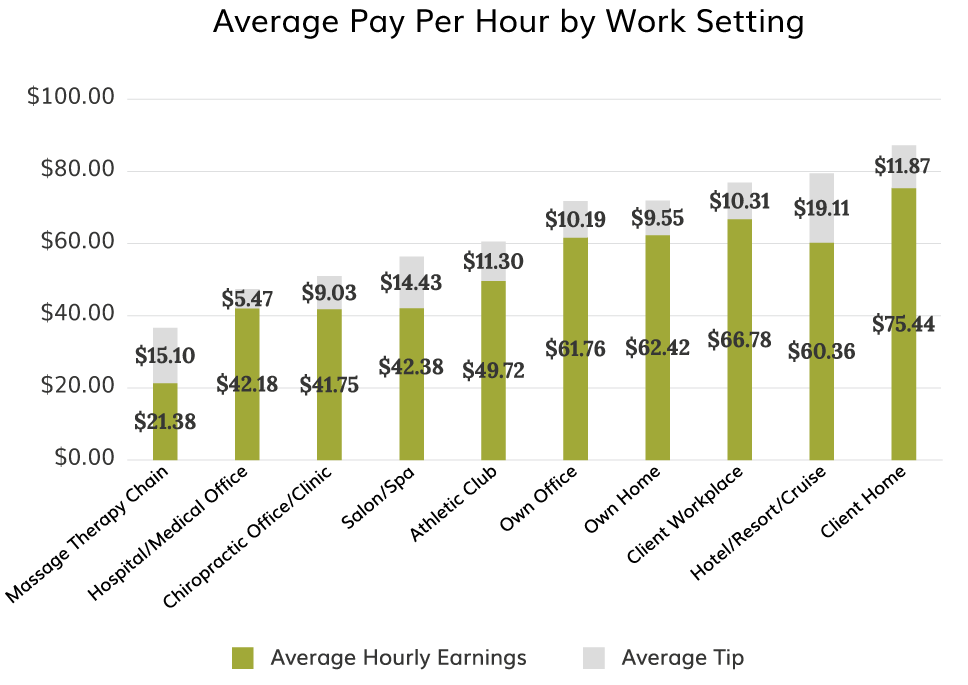
*Data sourced from the AMTA Research Report
So why the discrepancy in these numbers? A large factor is that massage therapy is not your typical 9-to-5 job, and the BLS calculates salaries based on a traditional workweek. “Fulltime for a massage therapist is technically less than 40 hours per week because of the nature of our job,” says Lisa McNeil, M. Ed, CFSS-M, a licensed massage therapist at the Wisconsin-based Momentum Movement Clinic, who also has years of experience working with Olympic and professional athletes.
The AMTA backs up this claim, citing an average work week of just 26.6 hours, with an average of 46 appointments per month. What’s more, massage therapists were only paid for about 70% of the time they worked, with the remaining hours spent doing non-massage activities related to running a business.
When it comes to salary, there are many other factors to consider as well. While our guide aims to give you a better understanding of what you could make as a massage therapist, remember that, as with most careers, the salary you earn varies widely depending on which city and state you live in, where and how much you work, any specializations that you have, and how good you are at marketing and garnering your clientele. Recent graduates of massage therapy schools also tend to earn on the lower end of the spectrum as it can take a number of years to build a reputation and a base of repeat clients.
Working as a self-employed massage therapist means you’ll be able to set your own rates, though what you can charge varies widely depending on where you live, the type of massage you perform, the length of the treatment, and whether you provide extras like aromatherapy or hot stone massage.
According to cost estimators on the professionals-for-hire-site Thumbtack, a standard massage runs between $110 and $140 on average. Massage therapists in major metropolitan areas might be able to charge two or even three times the amount as someone in a small town, so it’s best to do your research in order to decide what the market will allow.
An important thing to keep in mind is that as a self-employed massage therapist, you’ll be responsible for providing any necessary supplies such as a table or chair, sheets, pillows, towels, lotions, and oils. You’ll also need to factor in any costs associated with rent and utilities, scheduling software, advertising expenses, subscriptions to professional resources, fees for licensing, and continuing education. So, while you might charge over $100 an hour for a massage, your take-home pay will be far less.
All that may seem daunting, but the good news is that self-employed massage therapists can deduct most of these expenses from their taxes. Anything considered necessary to run your business can be itemized and potentially lead to a large refund. If you travel to your clients’ homes to perform massage, mileage and the cost of maintaining your car could be a deductible expense. It’s important that you keep a good record of all of your expenses and income (including tips) and file at the appropriate times throughout the year.
Once you’ve secured any licensing you need, the best way to increase your earning potential is to pursue board certification and specialization in a particular patient population or modality of massage—especially massage that’s applied as part of a medical treatment plan.
“Gone are the days when massage was strictly found at a spa,” McNeil explains. “Massage therapy in the last decade has gained traction as a legitimate adjunct to traditional medical services and, sometimes, an effective alternative to outdated medical practices. Hospitals will be hiring more massage therapists to aid with pain management, hospice care/comfort, and therapy rehab.”
But you can’t just graduate from a traditional program and expect to find a job working in a medical setting, says McNeil. “All students graduate with the ability to do relaxation/self-care, but few graduate with the ability to walk into a hospital or sports medicine clinic without additional education. With the right training, massage students can position themselves as medical providers and build a reputation within the medical community.” Part of that training, she adds, involves choosing a COMTA accredited program that’s strong in anatomy and physiology.
The National Certification Board for Therapeutic Massage & Bodywork (NCBTMB) offers board certification for professionals who want to demonstrate their dedication and expertise by going beyond the basic entry-level education requirements. Once certified, you can pursue additional education to earn specialty credentials in the healthcare areas of:
Massage therapy may not be among the highest-paid industries, but it can offer a good return on investment for the tuition paid and there are other benefits to consider. Many massage therapists enjoy having the ability to work part-time, make their own schedules, and earn extra money alongside another job. (Per the AMTA, 45% of massage therapists earn income working in a second profession.)
Of those who have an employer, the largest reported benefit was free or discounted massages. Between 30% and 50% of full-time employees reported receiving paid time off, health/dental/life insurance, a retirement plan, and free or discounted continuing education.
Find comprehensive information about becoming a massage therapist in the top states for the field. Read about required education, exams, licensing and find resources to help you thrive as a massage therapist.